Will maple trees still be on Mapleton Avenue in 30 years? The Tree Committee hopes so and is encouraging Mapleton residents to welcome free maple trees which will be planted in the State and Town Right of Way strip in front of their properties. Learn the legacy of the Mapleton maple trees in this history of the road.
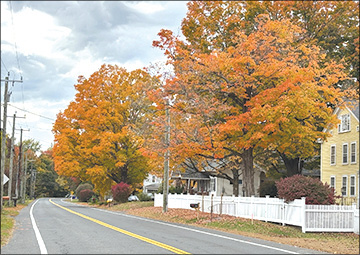
Mapleton Avenue today
In the 1600s, Mapleton Avenue was called Springfield Road, a path, wide enough for a man or a horse, which wound through the wilderness. Its crooked course was dictated by the contours of the terrain. It included our Main Street and converged with Northampton Road, today’s Hill Street and Remington Road, on what is now South Street, and continued to Windsor. Around 1664, the Hampshire County Court designated the Springfield Road a public highway. Those who settled Suffield surely traveled on it.
Even though the town records indicated that the original lots on Springfield Road had straight borders, in actual fact, they curved like the road. Concerned that future generations would argue about the shape of the lots, the landowners signed an agreement on April 19, 1697, specifying that “all the lots should run with an elbow, or crook as it now does” and “continue from one generation to another forever.”
Gradually Springfield Road became Crooked Lane. The local folklore is that an old and bent-over man named Lane, who actually lived on the road, gave his name to it. However, in 1684, the original lots were recorded as Crooked Lane plots, and that is how the name came into being. By 1710, Crooked Lane was written in town records for the road’s name and Springfield records followed suit in 1740.

Supposedly, George Washington traveled on Crooked Lane to reach Springfield. A farmer was told to move back as Washington approached, to which the farmer replied, “I’ll give him half the road and that’s all, even if he is president.” Washington agreed and said, “He’s right.”
In another story, John Adams, when he was president, called upon the Adams family who lived on the road and claimed kinship with them.
In the mid-1800s, the Crooked Lane neighborhood organized “progressive” cultural activities. They formed a Farmers club, prayer meetings, a “Lyceum,” and later a Grange and a Reading Club. When the weekly entertainments and lectures outgrew their district school, the neighborhood funded and built the Central Hall of Crooked Lane. The building is now known as Mapleton Hall, the home of the Suffield Players.
Included in the program for the dedication of the Hall was a tribute to the neighborhood from the Stubberts, who had lived on Crooked Lane for eight years. “Scarcely ever do you observe in a rural district, so much harmony, unanimity and brotherly love as is noticeable here. Whatever may be for the benefit of the community is mutually and heartily undertaken by all.”
Still the question remains. Why was the road changed from the memorable Crooked Lane to Mapleton Avenue?
When Arthur Sikes, a distant long-ago cousin of Arthur Sikes, who is a current Suffield resident, received approval to operate a post office from his house on Crooked Lane, he ran into trouble. Postal authorities refused to accept Crooked Lane as a proper branch name. A new name was needed. The maple trees growing along the road may have provided the inspiration.
David Sikes, a Revolutionary War soldier and veteran of the Siege of Boston, planted maple trees on his Crooked Lane property. Nathan Clark, also fond of maple trees, traveled to the woods north of Westfield for maple trees, which he planted on the road. Other neighbors followed their examples and the road became lined with maple trees.
There are many old maple trees still remaining on Mapleton Avenue. It is possible that the early residents of Crooked Lane planted them. However, the lifetime of a maple tree is between 150 and 300 years. The trees they planted would be very old. The Tree Committee is concerned that Mapleton Avenue won’t live up to its name in 30 years unless more maple trees are planted. Help honor the community spirit of Crooked Lane and its love of maples. Ask for a tree by emailing
TreesforSuffield@gmail.com or use the following QR code.

Sources:
1. Mrs. John Henshaw in a paper read before the Mapleton Reading Club on March 14, 1945 (Kent Memorial Library archives).
2. Hezekiah S. Sheldon’s A Documentary History of Suffield: in the Colony and Province of Massachusetts Bay, in New England, 1660-1749. Springfield, Mass.: C.W. Bryan Co., 1879-1888.
3. Dedication of the Central Hall of Crooked Lane, Suffield Conn., and the Reunion Exercises held on Jan 24, and Feb. 3, 1883 (Kent Memorial archives).