The John Sullivan & Son Tobacco Farm was started by my grandfather, John L. Sullivan. Our farm was located at 432 East Street across from the Nicholson Funeral Home, which is now the Nicholson & Carmon Funeral Home. We lived in a two family farm house. My dad John, my mother Gen, my brother Jim, and I lived upstairs. My great-grandfather John Land and great-grandmother, Ellen lived downstairs. My grandfather James and grandmother Clara lived in the house north of our farmhouse. James was the first Constable in town. He was also a First Selectman for about 12 years.
Growing up on a farm in the 1940-1950-1960s kept me very busy. At age 8 I drove a horse drawn tobacco rack. We were the last farm in town to use horses. We used them for everything – plowing the fields, wheel harrowing, setting tobacco and haying the fields. We had twelve work horses and one riding horse. The last pair of horses we got were New England horse drawing champs. My father’s friend, Fred Noble, gave them to my father. Their names were Doc and Diamond.
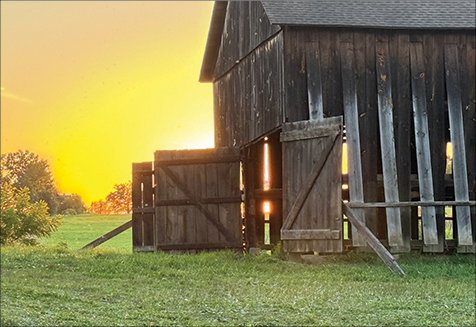
Tobacco barns evoke fond memories of the past in Suffield.
While driving a horse drawn tobacco rack being pulled by a New England pulling champ, Doc, I backed into the corner inside the shed to be unloaded. The fellow unloading the wagon put the hook that holds the sides together on the shed brace. When we moved up, Doc felt the resistance and started dancing up and down like pulling at the fair. When the hook was unhooked, Doc, myself, and the wagon shot to the other end of the shed. We went around the shed and waited until Doc calmed down.
Another experience I had with the horses involved a fall by the corn crib. I was sitting on the fence around the corn crib. I fell backwards and landed on my back and head. When I woke up three horses were standing over me breathing on me to keep me warm. It was about 10 degrees. The ground was frozen. I guess horses will do anything for an ear of corn.
I had a great neighbor, Mr. Jenkins. He always planted a garden. He got me interested in growing different things, and also raising Banty chickens. I built a chicken coop with Mr. Jenkins to keep them in. I would feed them before I went to school and chop the ice out of the water barrel for the horses. On Sundays Mr. Jenkins and I would go fishing in the canal or look for arrowheads in the freshly plowed fields.
We raised broad leaf tobacco until 1953. In 1954 we switched to shade tobacco for six years. When cigar makers homogenized the whole plant, they no longer needed the pristine leaves. This forced the small farmers like us out. I enjoyed plowing when we bought a 1955 Farmall H. tractor. Chores on the farm also involved putting hay in the rack for the horses.
After school I would work at Sherwin Nicholson’s Funeral Home, raking leaves and building stalls in his barn. If there was no work at Sherwin’s, I worked at Jimmy Fleming’s dairy farm unloading hay or hauling silage. If there was any time left, I worked on my 1932 Ford hot rod. There were lots of memories. I made many friends, learned to grow other things, and developed a good work ethic. I wouldn’t change any of it.
My senior year after I graduated, I got a job with Nicholson Brothers’ Tobacco driving an old school bus, picking up the boys in Enfield who worked on the Nicholson Tobacco Farm. It was a great experience driving a bus across the old Thompsonville/ Suffield Bridge. It didn’t look like farming was an option anymore. We eventually sold the farm.
After high school I got my first job at United Gear in Suffield. I was an apprentice machinist. I learned a good trade which stayed with me the rest of my career. My last stop was Hamilton Standard Experimental Test and Space and Sea. I still loved farming.
After work and weekends, my wife Val, and I raised Christmas trees on our small farm. We sold them for 35 years. Our two children, Michael and Karen enjoyed working with us during this time. We also had vegetable gardens, apple trees and blueberries. I don’t think I would change any of it. You can take the farmer off the farm but you can’t take the farm out of the farmer. Anybody who worked on a tobacco farm found that their next job was a step up! That’s my story and I’m sticking with it!