The minute you walk into the New England Air Museum (NEAM), you know you are in for a visual, historical and educational treat. Greeting you in the museum’s spacious new lobby are hundreds of commercial and military aircraft models suspended overhead, along with an Apollo-era spacesuit made by our own Hamilton Standard — now Collins Aerospace — back in the day. NEAM is the seventh largest air and space museum in the country (and the largest in New England), with more than 100 aircraft, numerous engines, and acres of aviation and aerospace artifacts.
I have to admit, I had not been to the museum since my kids were young, and we came for an open cockpit day. On this return visit, I was fortunate to receive a private tour from Scott Gentry, Vice President of Development.
From the lobby, you enter the military hangar, a 37,000-square-foot space — just shy of an acre — housing more than a dozen military aircraft as well as historical engines. One of the engines is the fastest ever produced, pushing the SR-71 Blackbird Spy Plane to more than 3.5 times the speed of sound. The museum’s collection is too large to fit inside the current hangars, and at least another dozen aircraft are stored away. NEAM rotates its displays so that new aircraft are featured on a regular basis.
Two of the military aircraft would be especially familiar to lifelong Connecticut residents such as me: an F-100 Super Sabre, stationed with the Connecticut Air National Guard from 1971 to 1979, and an A-10 Thunderbolt, which served from 1979 to 2008. What truly blew me away, however, was the sheer size of the F-15 on display. Also featured are helicopters designed and built right here in Connecticut by Sikorsky and Kaman.
Docents are stationed throughout the hangar, eager to answer questions and share their deep knowledge of the aircraft and the people behind them. Docents such as Terry Fogarty and Vincent Wu help bring the collection to life for visitors. “We’re not an aircraft zoo,” said Scott Gentry. “We are truly a historical and educational museum of aircraft and the amazing people that designed and flew them.”
Our next stop was the New England Women in Aviation Exhibit, which was completed in 2022. It explores the inspirational stories of trailblazing women whose contributions were integral to our region’s aerospace history. It is well worth taking the time to read each display. Visitors of all ages will come away impressed by what these women achieved, and I suspect many young people — especially young girls — will leave feeling newly inspired. According to Stephanie Abrams, President and CEO, “we want young people, both girls and boys, to move through these galleries and see not only the remarkable achievements of those who came before them, but the possibilities that may lie ahead for them as well.”
Being half Polish, I especially appreciated our next stop: The Tadeusz Kosciuszko Squadron, Defenders of Freedom, 1919–1946. Tadeusz Kosciuszko (1746-1817) was a Polish military engineer, statesman, and military leader who became a national hero in Poland, the United States, Lithuania and Belarus. He fought in the struggles of the Polish-Lithuanian Commonwealth and also on the American side in the Revolutionary War. The exhibit tells a story many visitors may not expect to find here, a story of international alliance, courage and a shared fight for freedom. It brings well-deserved attention to unsung heroes whose role in the battle of Britain, and in the broader defense of liberty, is too often overlooked. In doing so, it adds a deeply human and global dimension to aviation history, reminding us that the story of flight is not only one of machines, but of ideals, service and sacrifice.
We next made our way into the Civil Aviation Hangar. There, I had the chance to step inside a Douglas DC-3, the workhorse of the early commercial airline industry. I have to admit there was more legroom and the seats were more comfortable than on some of the modern aircraft I have flown on lately. In addition to the DC-3, the hangar includes many other aircraft, including the impressive VS-44A Excambian flying boat and a striking new Sikorsky exhibit.
The Sikorsky Exhibit is one of the museum’s standout experiences and a particular point of pride for Connecticut. Through artifacts, interpretive displays, and immersive media, it celebrates the genius, daring, and innovation of Igor Sikorsky, whose work changed aviation history and helped establish Connecticut as a center of aerospace achievement. Mike Thornton, curator and director of interpretation, said, “our goal is not just to display great Sikorsky products, but to help people feel the scale of the ideas, the risks, and the human brilliance behind them.”
The most impressive stop on our tour may well have been the Restoration Building. Scott explained that the New England Air Museum is powered by volunteers, approximately 150 people who donate more than 31,000 hours of their time each year. NEAM is dedicated to preserving and presenting historically significant aircraft, aircraft engines and aviation artifacts, and it has one of the finest restoration programs in the country. The restoration hangar, completed in 1989, encompasses 11,200 square feet and is organized into workstations for machining, sheet metal fabrication, engine restoration, welding and storage of aircraft parts and materials. At the moment, the museum has three active restoration projects underway: a Navy E1-B Tracer, an Air Force A-7 Corsair II, and a Coast Guard HU-16 Albatross.
Our final stop was the B-29 Superfortress and Tuskegee Airmen exhibit. The B-29 alone is worth the visit. It is enormous — so large, in fact, that one comes away understanding why it deserves its own hangar. The Boeing B-29 Superfortress was a four-engine heavy bomber designed by Boeing and flown primarily by the United States during World War II and the Korean War. It is a remarkable aircraft and is in fact the finest restoration of its kind in the world.
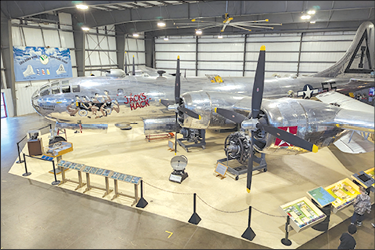
Photo by Ray A. Dalrymple
The B-29 Superfortress.
But it was the Tuskegee Airmen exhibit that stayed with me most deeply. The Tuskegee Airmen were the first African American military aviators in the United States Armed Forces. What these men endured, and what they gave of themselves, is truly remarkable and inspiring. One quote from a Tuskegee Airman that I will not soon forget was this: “I felt safer overseas at war than I did at home.” A sad and sobering commentary on the racism and discrimination of the time.
The Tuskegee Airmen Exhibit is an official stop on the Connecticut Freedom Trail, recognizing its importance in telling the story of African American history, service, and sacrifice. The museum’s theater videos are award-winning, adding another powerful dimension to the visitor experience by bringing these stories to life through film and first-person voices.
Amanda Goodheart Parks, Director of Education, said, “By connecting the past, present, and future of aerospace, our goal as a museum is to spark curiosity, expand understanding, and inspire the next generation of young people to pursue their dreams, just as the innovators and pioneers featured in our exhibits, collections and programs once did.”
The New England Air Museum offers far more than extraordinary aircraft displays. In a setting unlike any other in the region, the museum features educational programs for students and families, flight simulators, open cockpit opportunities, special events throughout the year, and venue rentals for private and corporate gatherings. Whether you are an aviation enthusiast, a history lover, or a family looking for an unforgettable day out, the museum offers something special.

Photo by Ray A. Dalrymple
Docents Vincent Wu, Terry Fogarty and NEAM Vice President of Development, Scott Gentry
For information on hours, admission, memberships, educational programs, private events, and special experiences, visit www.neam.org or call 860-623-3305. The New England Air Museum is located just behind Bradley International Airport, in Windsor Locks.