Fire House-1 and Suffield Middle School require significant investment identified in the 2023 Facilities Master Plan. The question isn’t whether the town will spend money, it’s whether that spending will finally solve the problems.
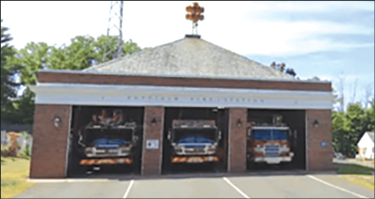
Fire House – 1
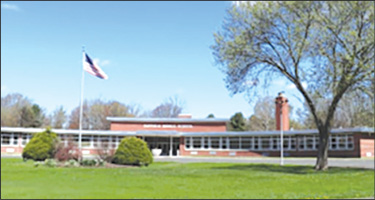
Suffield Middle School
June 2026
Two of Suffield’s most essential public buildings stand at a crossroads. Fire House-1 at 73 Mountain Road has anchored our fire department’s operations for over 64 years. Suffield Middle School has educated generations of the town’s young people. Both were designed and built in the early 1960s for a different era and are now straining under demands they were never meant to meet. Residents deserve to understand the true cost of maintaining the status quo before any vote is taken.
The Suffield Permanent Building Commission (PBC)—a volunteer body of eight residents appointed to manage capital building projects, wants to be direct: doing nothing, or only the minimum, is not free. For Fire House-1, the minimum “keep-it-running” path is estimated at $3.8 million. For Suffield Middle School, the minimum Capital Improvements Plan (CIP) is estimated at $75.4 million if completed in two years. Neither figure produces a building that meets the needs of those who depend on it. Both represent real town money spent without solving the problem.
The choice before Suffield is not “spend or don’t spend.” It is “spend to fix the problem or spend to delay it.”
Over the past year, the PBC and the town have engaged two highly experienced professional firms to study both buildings thoroughly and develop a full range of options for the community to consider. Colliers Engineering & Design serves as the Owner’s Project Manager (OPM) for both projects, providing independent cost estimating, project management oversight, and technical guidance to the Commission. Tecton Architects, a Hartford-based firm with deep experience in public safety facility design, has led the architectural study for our Fire Headquarters. Together, these teams have conducted facility assessments, engaged with the Fire Department, Fire Commission, and School District, developed conceptual designs, and produced detailed opinions of probable project costs for every option on the table.
The referendum to bring these investments to Suffield voters is now targeted for early spring 2027. The Commission moved the date from November 2026 to allow more time for residents to absorb information, attend community sessions, and ask questions. Information sessions will be announced in the Observer and on the Town of Suffield’s website. Every resident is encouraged to participate.
How the PBC Works—and Who It Works With
The Permanent Building Commission is a volunteer body of eight Suffield residents with building industry experience, appointed by the Board of Selectmen to manage capital projects from concept through close-out. The PBC acts as the town’s advocate—holding professional teams accountable, managing budgets and schedules, and protecting the community’s investment.
For these large projects, the PBC does not work alone. Colliers Engineering & Design was engaged as OPM for both studies, bringing independent technical expertise to evaluate proposals, validate cost estimates, manage procurement, and ensure the town is not relying solely on a single firm’s recommendations. Colliers led the budget analysis for Suffield Middle School and provided cost oversight for the Tecton-led Fire Station 1 study.
Tecton Architects was selected to lead the Fire House 1 feasibility study. Their team worked with the Fire Department and Fire Commission, toured a comparable fire station in Bloomfield, and developed three conceptual design options with detailed plans and cost estimates for comparison.
This process is structured and professionally managed to give residents the most reliable picture possible of what each option will cost and deliver.
The Board of Selectmen tasked the PBC to evaluate the Facilities Master Plan and recommend actions to address identified issues. The PBC’s studies, options, and cost estimates flow from that charge. After the PBC’s recommendation, the Board of Selectmen and Board of Finance will analyze the financial implications and present them to residents before any vote. The PBC answers questions about what is needed and what it will likely cost; town financial leadership will address how it is paid for and what it means for taxpayers.
Fire House 1: Is the Current Building the Long-Term Answer?
Fire House 1 is the operational headquarters of the Suffield Fire Department. The building’s condition is directly connected to the department’s ability to protect life and property. The existing station, built in the 1960s and totaling 5,800 square feet, fails on important dimensions of a modern public safety facility. It is not ADA-compliant, lacks appropriate quarters for women, and the apparatus bays do not meet National Fire Protection Association (NFPA) standards. There is no dedicated decontamination space, posing occupational health concerns. Fire Safety Training space is minimal, the building contains hazardous materials, and the structure does not meet current energy or building codes.
The Tecton study identified a properly sized station of approximately 15,080 gross square feet—nearly three times the current footprint. This program was developed with the Fire Department and benchmarked against the recently complete Bloomfield Fire Substation #3. The prioritized program includes four drive-through apparatus bays, decontamination and SCBA rooms, turnout gear storage, bunk rooms, day room and kitchen, fitness area, chief’s office, watch room, and all required services. An optional alternate would add a properly sized training space and double as another community meeting room.
If the town proceeds with identified repairs ($3.8 million), Fire House 1 will still not be ADA-compliant, will still fail NFPA standards, and will still lack decontamination facilities, office space and proper bunk space.
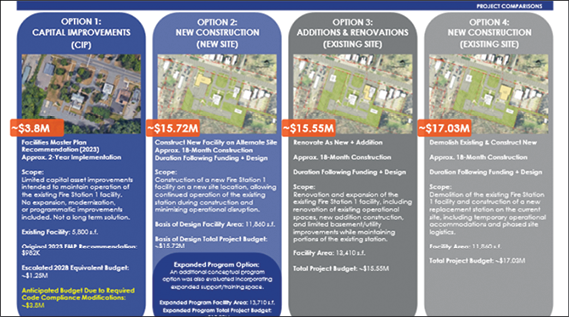
Fire House 1—Options and Estimated Total Project Costs
• Option 1: Continue Capital Improvements Only (~$3.8M): Addresses basic deferred maintenance only. Does not achieve code compliance, ADA access, NFPA best practices, or adequate space. Not a long-term solution to meet identified program needs.
• Option 2: New Construction on a New Site (~$15.7M, or ~$17.9M with training room): A new 11,860 sq. ft. station on the current Town Hall Annex, allowing the existing station to remain operational during construction. The existing FH-1 Building would be repurposed for another town function. This cost would be identified once the new purpose is designated.
• Option 3: Addition and Renovation on the Existing Site (~$15.5M): Renovation plus new addition (13,410 sq. ft.), requiring temporary relocation during construction. The budget estimate includes a higher contingency due to unknown hidden conditions.
• Option 4: New Construction on the Existing Site (~$17.0M): Demolish current building and construct a new 11,860 sq. ft. station, with phased temporary accommodation. The Fire Department would need to operate from another station during the period of construction.
Suffield Middle School: A Building That Must Serve Every Student Well
Suffield Middle School is where students spend formative years. Science labs, special education, regional programs, art, music, physical education, library resources, and district administration all operate from this building. The quality of these spaces shapes what is possible for students and staff.
Like Fire House 1, the school has not kept pace with its demands. Built as a High School in 1962 and converted to the Middle School in 2001, instructional spaces are not sized or configured for modern teaching. Special education facilities do not meet current standards. Building systems are aging, inefficient, and at the end of useful life. Central office and regional special education spaces are inadequate and for some purposes, do not exist.
Colliers Engineering & Design led the facilities analysis for the Middle School, coordinating with district administration and the PBC. Their work included a detailed assessment, program study, and development of three options with high, low, and probable budget estimates—each broken out by town share and state reimbursement.
If the town opts for the minimum Capital Improvement Program (CIP), the estimated cost is $75.4 million, and the school will still lack updated facilities identified in the Educational Specification. The state reimburses an estimated $12.9M, leaving the town responsible for about 83% of the cost.
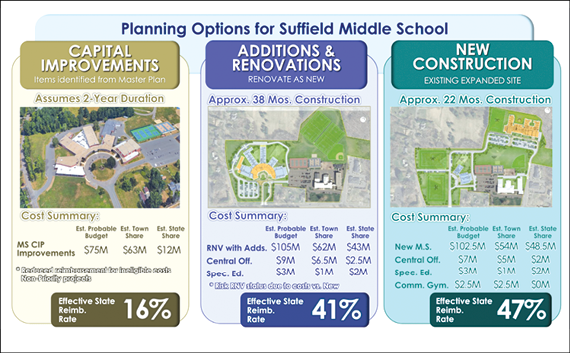
Suffield Middle School—Options, Estimated Total Costs, and State Reimbursement
• CIP Option (Estimated town share: ~$63M – State share: ~$12M):
Total estimated cost (~$75M): Addresses critical repairs and systems replacement without full renovation or replacement. Does not modernize instructional spaces or address special education comprehensively. Captures less state reimbursement.
• Renovation Option (Town share: ~$62.0M – State share: ~$43M):
Total Estimated cost (~$105M) Comprehensive ‘renovate as new’ approach with additions, new Central Office, and Regional Special Education renovations. Town share: ~$62.0M. State share: ~$43M. Modestly lower town share than CIP, and results in a fully updated facility.
New School Option (Town share: ~$62.5M – State share: ~$52.5M)
Total Estimated Cost (~$115M):
* New Middle School Building (Town Share $54m, State Share $48.5m)
* Renovations to Central Office (Town Share $5m, State Share $2m)
* Regional Special Education (Town Share $1m, State Share $2m)
* Renovation to existing gym/fitness areas (Town Share $2.5m, State Share $0m)
* Maximizes state support.
The net difference in Suffield’s share between the minimum CIP and a full renovation or new building ranges from about $2 million to $8 million, but the difference in what those dollars deliver is substantial. Residents will be able to weigh not just the total numbers but the benefits that each option produces.
What Comes Next
The PBC will present the Best Options to the Board of Selectmen in a Special Meeting in July. The BOS will in turn charge the Board of Finance to evaluate the costs and return with the impact to the town budget and the effect on taxes.
The PBC, Board of Education, and Fire Commission will hold community information sessions before the spring 2027 referendum. These sessions will feature presentations and Q&A with Colliers Engineering & Design, Tecton Architects, and Commission members. Formal Open House dates will be announced in the Observer and on the town website.
Mark your calendar for an early opportunity: the PBC will have an information booth at the Suffield Summer Carnival on June 27, 2026. Members of the PBC, Board of Education, and Fire Commission will be available to answer questions and hear concerns. This is an informal opportunity to speak with project leaders face to face.
Study materials, cost summaries, and conceptual design documents will be available on the Town of Suffield’s website as finalized. The PBC will also present updates at its regular monthly meetings, open to the public and listed on the town calendar.
The PBC is an appointed volunteer body. Each member has given significant time because these buildings matter, not as abstractions, but as the places where your neighbor suits up when your house is on fire, and where our teachers, children, and grandchildren spend their days learning. The planning process has been thorough, independent, and honest about both the costs of action and inaction.
The referendum target date is early spring 2027, to be set by the Board of Selectmen. We hope you will attend a community session, read the full materials, and vote with knowledge and confidence.
For questions about the projects, contact the Permanent Building Commission. Scan the code to the Town of Suffield website at www.suffieldct.gov, attend a regular monthly meeting on the 1st and 3rd Thursday of each month, or write to the Commission at Town Hall, 83 Mountain Road, Suffield, CT 06078.