Permanent Building Commission Presented Recommendations for Middle School and Fire Station #1
On October 15, the Suffield Permanent Building Commission (PBC), together with its consultants Colliers Project Leaders and Tecton Architects, presented recommendations for the replacement of Suffield Middle School and Fire Station #1 at a joint meeting of the Board of Selectmen and Board of Finance.
These recommendations represent the culmination of years of facility assessments, master planning, feasibility studies, and evaluations of renovation and replacement alternatives. The Commission’s responsibility has been to evaluate the condition, functionality, and long-term viability of these facilities and identify the most appropriate solutions for Suffield’s future. Now, the Board of Selectmen will review the information and begin their own evaluation of options to decide the course of action.
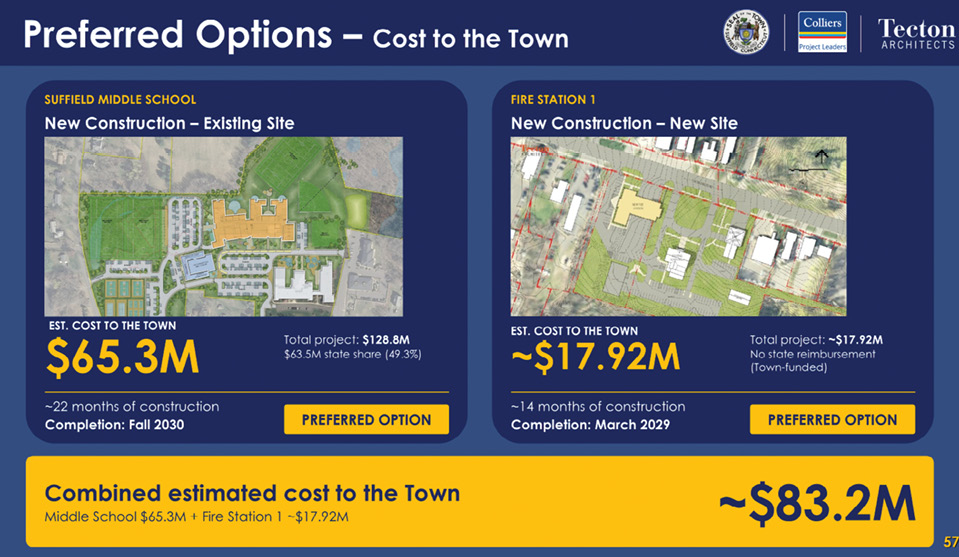
The combined estimated cost of the recommended projects is approximately $146.7 million, with an anticipated Town share of approximately $83.2 million after State reimbursement. The meeting also included a preliminary financial analysis of the Town’s broader ten-year capital needs, prompting important discussion about affordability, debt capacity, and potential financing strategies.
Suffield Middle School Proposal
The Permanent Building Commission recommends construction of a new Middle School on the existing 350 Mountain Road campus, while retaining and renovating the auxiliary gymnasium for community use and incorporating improvements to the Central Office.
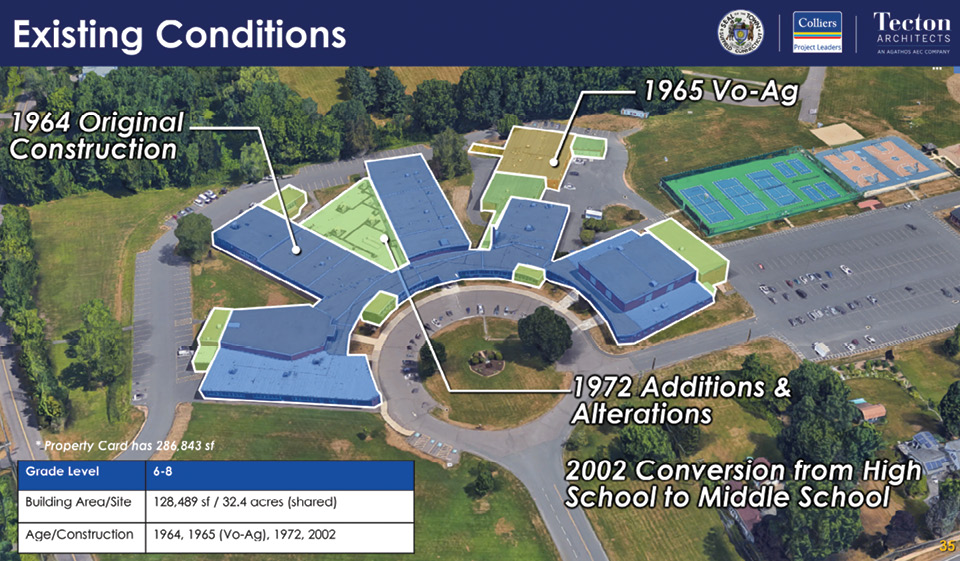
The existing school, originally constructed in 1964 as a high school, has significant infrastructure and functional deficiencies. Major building systems are approaching or have exceeded their useful lives, and the building’s configuration does not adequately support contemporary middle school educational programs. Accessibility, ventilation, acoustics, and the availability of natural light are among the concerns identified through the assessment process.
The Commission evaluated several alternatives, including comprehensive capital improvements, renovation and expansion, and new construction.
The estimated costs to the Town illustrate why replacement emerged as the preferred option:
Alternative – Estimated Town Share
Comprehensive capital improvements $63.0 million
Renovate as New $73.0 million
New construction $65.3 million
While comprehensive improvements would address many aging building systems, they would not fully resolve the educational and functional limitations of the existing facility. Renovation and expansion would address those needs but would cost the Town more than new construction and require approximately four years of phased work around students.
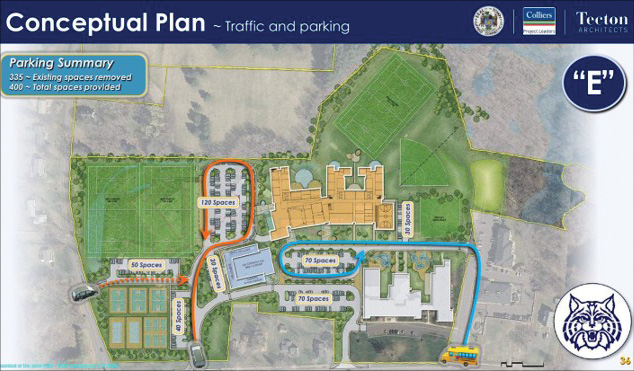
New construction provides the opportunity to develop a modern, efficient educational facility while students continue attending classes in the existing building. The proposed design also improves campus circulation, separates bus and parent traffic, provides improved community access to recreational facilities, and incorporates energy-efficient building systems.
The total estimated project cost is $128.8 million, including the Central Office and auxiliary gymnasium improvements. Anticipated State reimbursement of approximately $63.5 million would reduce the Town’s share to $65.3 million. These figures remain preliminary and will be refined through design and the State reimbursement process.
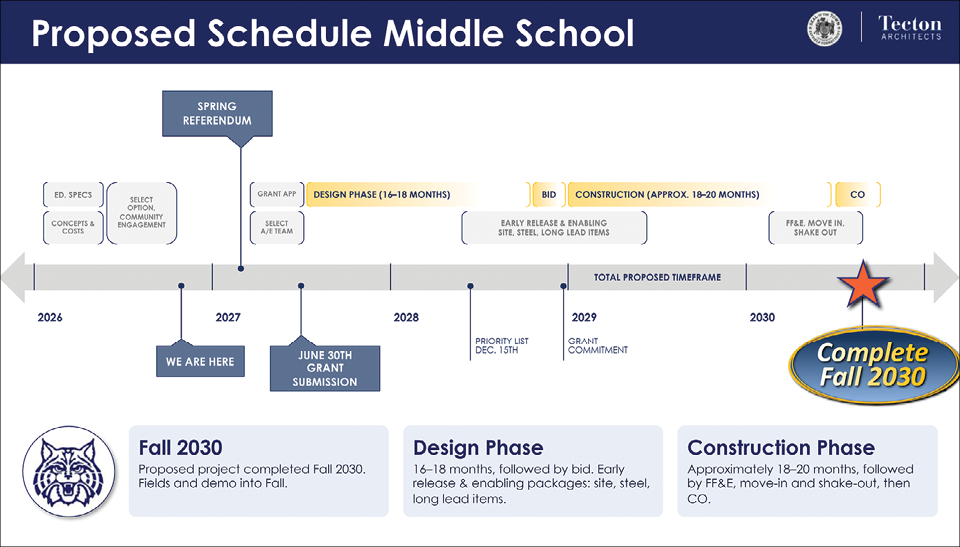
If approved at a spring 2027 referendum, the project would proceed through approximately 16 to 18 months of design followed by 18 to 20 months of construction, with anticipated completion in fall 2030.
Fire Station #1 Proposal
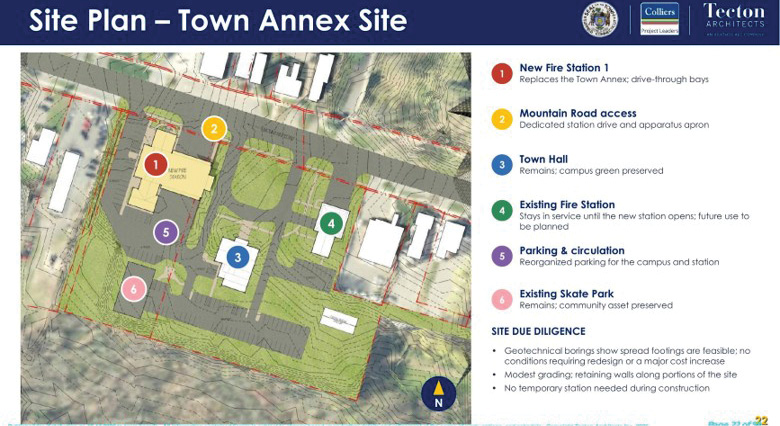
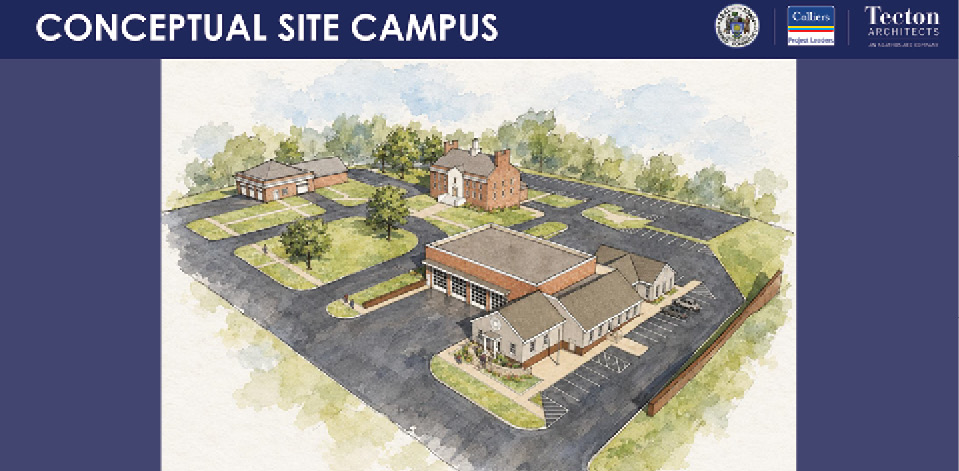
The Permanent Building Commission (PBC) also recommends replacing Fire Station #1 with a new approximately 13,600-square-foot facility on the Town Annex property adjacent to Town Hall.
The existing station presents significant operational and safety limitations. Apparatus bays are undersized for modern emergency vehicles, circulation is constrained, and the building lacks appropriate separation between contaminated equipment and firefighter living areas. These conditions affect daily operations and cannot be fully addressed through routine maintenance or limited renovations.
The proposed facility would include four drive-through apparatus bays, improved decontamination facilities, training and support spaces, and safer circulation for firefighters and emergency vehicles.
The PBC evaluated alternatives involving improvements to the existing station as well as new construction. While capital improvements could extend the existing building’s service life, they would not adequately address its fundamental space and operational limitations. New construction was therefore identified as the preferred long-term solution.
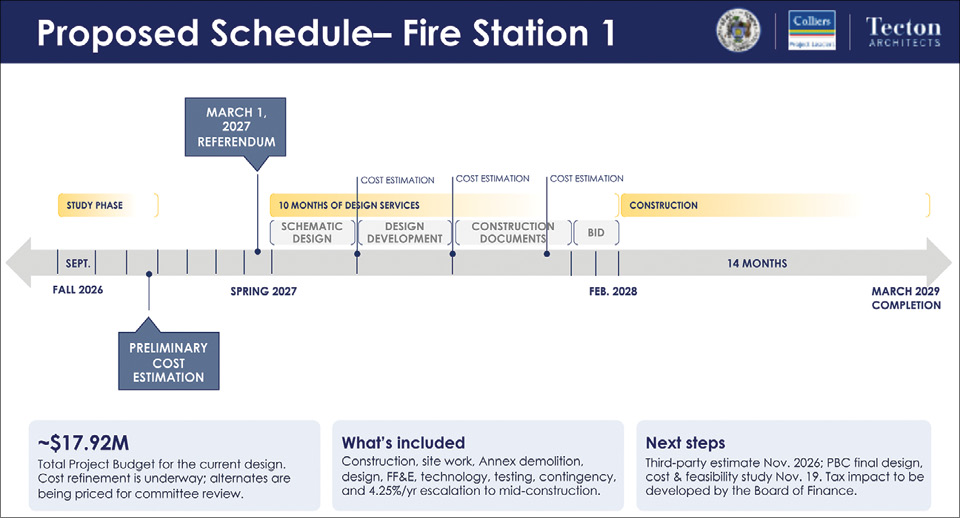
The current project estimate is approximately $17.9 million, with no State reimbursement assumed. A third-party cost estimate is expected in November, and the PBC anticipates presenting its final design, cost, and feasibility study on November 19.
If approved through a spring 2027 referendum, the new station could be completed by March 2029. The existing station would remain operational during construction, avoiding the need for temporary facilities.
Financial Considerations and the Path Forward
The October 15 meeting also included a preliminary financial presentation examining the Town’s anticipated capital expenditures over the next ten years.
The analysis identified approximately $171 million in total Town capital needs, including the Middle School and Fire Station projects, along with other planned investments in roads, bridges, municipal facilities, equipment, and infrastructure. The two recommended building projects represent approximately half of that total.
The Board of Finance presentation examined alternative financing approaches and their potential effects on property taxes and municipal debt. One modeled scenario projected approximately $7,500 in additional cumulative property taxes over ten years for a home valued at $500,000, compared with a baseline assuming 2.5% annual tax growth.
It is important to recognize that this figure reflects the Town’s broader ten-year capital program, not simply the Middle School and Fire Station projects. It is also a preliminary financial projection based on assumptions about borrowing, future operating budgets, capital expenditures, and other variables that remain subject to review.
The presentation raised legitimate concerns about the Town’s debt policies and its ability to fund multiple significant capital needs within a relatively short period. Potential strategies discussed included adjusting project timing, evaluating financing structures, reconsidering the timing of other capital expenditures, and pursuing additional State funding.
These alternatives require further analysis and coordination among the Town’s elected boards, financial advisors, and project consultants.
The PBC recognizes the importance of these financial considerations. At the same time, delaying construction or pursuing limited repairs does not eliminate the underlying facility needs. Continued investment in aging infrastructure, potential construction cost escalation, operational inefficiencies, and the availability of State reimbursement must also be considered when evaluating the long-term financial implications of each alternative.
Looking Ahead
The October 15 meeting represented an important milestone in the Town’s facilities planning process, but it was not the conclusion of that process.
The Permanent Building Commission’s charge has been to evaluate these facilities, study the available alternatives, and provide recommendations based on building conditions, operational requirements, educational needs, and long-term value to the community.
Following extensive investigation and analysis, the Commission believes replacement of both Suffield Middle School and Fire Station #1 represents the most responsible long-term approach. These recommendations are not based solely on the age of the buildings, but on the significant investments required to maintain them, their existing functional limitations, and the comparative costs and benefits of the available alternatives.
The next phase will require continued collaboration among the Permanent Building Commission, Board of Selectmen, Board of Finance, Board of Education, Fire Commission, and the community to evaluate funding opportunities, refine project costs, and establish a financially responsible path forward.
The challenge before Suffield is not simply whether these buildings need investment, but how to make that investment in a way that responsibly serves both current taxpayers and future generations.
The Permanent Building Commission remains committed to providing objective information, transparent recommendations, and responsible stewardship of the Town’s public facilities as this important discussion continues.
Editor’s Note: The Permanent Building Commission plans to update our readers through the Observer paper and website continually as developments occur.
It’s Our Town!
Now is the time to let your Board of Selectmen and Commission members know your thoughts!