The CT state government distributes Statutory Aid to Municipalities annually. Many of the people who control the state government like to remind the citizens about how generous they are when doing so. But are they really?
I investigated what the citizens of each municipality pay in personal income taxes to the state and compared it to the money the municipalities get back in state aid, using the most recent data available. It turns out that, in total, municipalities only get back 37% of what they pay in income taxes. If you drill down further, it’s clear that some municipalities make out very nicely, while others don’t do well at all.
Of the 169 municipalities in Connecticut, 23 get more state aid than what their citizens pay in income taxes while the remaining 146 get less, as follows:
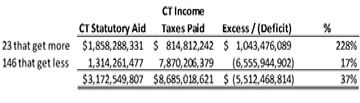
Most of the municipalities that get more are cities and larger towns (e.g., Hartford, Bridgeport, New Haven, Waterbury), while suburban and rural towns like Suffield get less.
Looking at the data, it’s reasonable to conclude that the state income tax is largely a mechanism to transfer wealth and income from some municipalities to others. It’s also reasonable to ask whether all this money transferred to Connecticut cities actually solved any of their problems.
The taxpayers of Suffield only get back 31% of what they pay, as follows:

To make matters worse, even though the cost of everything, including Town government, rises each year due to the impact of inflation, state aid to Suffield has decreased over the last decade, as follows:
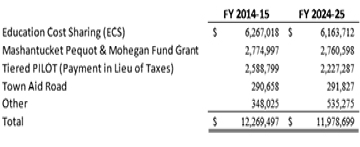
In contrast, Hartford’s state aid increased by approximately $50,000,000, or 20%, over the same period.
This reduction in state aid, coupled with rising expenses, has resulted in a larger burden on local property taxpayers to fund the Town government (68% in FY 2024-25 compared to 65% in FY 2014-15 and, going back further, 61% in 1999-00).
This entire system of taxation and redistribution in Connecticut is very unfair and getting worse, especially when you also factor in all the unfunded mandates (over 1,400 and counting) on local governments and the continued erosion of local tax bases through tax exemptions and other changes. Add on top of that excessive regulation on businesses and poor energy policy and the result is the affordability crisis that we are all dealing with. The impact is reflected in Connecticut losing population in relation to other States, as evidenced in our decrease in Congressional representation and declining student counts throughout the State.
So, while some may continue to refer to the money we get back as “state aid,” I liken it more to a bully taking our dollars, spending it on their friends, and throwing the change back at us.