The Board of Finance (BOF) has completed its review of the Town’s budget for the fiscal year ending June 30, 2027. A Public Hearing will be held on April 22 to review the proposed budget, which is subject to change based on feedback received at that meeting. The budget will be presented at a Town Meeting for approval on May 6.
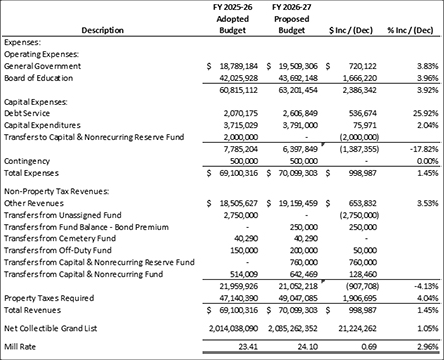
The chart at the lower right summarizes the proposed fiscal year 2026-27 budget compared to the current year budget.
The General Government budget increase is due primarily to an increase in wages ($319,500) and higher 457(b) Plan contributions ($64,550), both of which are higher than normal due to the impact of recently settled Collective Bargaining Agreements (CBAs) with the Police, Town Hall, Library and Dispatch. Other drivers of the budget increase include higher utility costs (i.e., trash collection, electricity, and hydrant water – $130,213), higher road paving expenses ($94,404, offset in revenue), higher landfill permitting and engineering fees resulting from a state mandate ($29,725), and the first year of an annual software fee related to the new townwide emergency radio system currently being installed ($30,000). Partially offsetting these higher expenses is a decrease in medical insurance ($115,571) resulting from the CBA’s noted above.
The Board of Education budget increase is driven by contractual salary obligations, a significant rise in health insurance premiums, and the expiration of a very favorable five-year transportation contract. These cost pressures are partially offset by staffing reductions and a proactive effort to reduce outplacement tuition and transportation expenses where appropriate. Overall, the budget preserves the programs and services necessary to support student success and continue progress in teaching and learning across the district, while remaining mindful of the budgetary impact on the community.
Capital Expenditures includes over forty different items recommended by the Advisory Commission on Capital Expenditures (ACCE) that are necessary to repair, replace and/or improve the Town’s capital assets. The largest single item on the list is road repairs and maintenance ($1,200,000). This amount was determined based on a detailed road study that was recently completed. Other larger items include the replacement of the HVAC system at the police station ($300,000), pre-referendum expenses related to the Facilities Master Plan ($265,000), replacement of the auditorium and stage lighting at the high school ($195,000), and two police cruisers ($150,000).
Debt service is higher due to the first year of interest payments on capital include the townwide emergency radio system, major school renovations (HVAC, roofing, exterior, and flooring) and bridge and road reconstructions.
On the revenue side of the ledger, the non-property tax revenue is driven by an increase in interest income ($250,000) on Town deposits driven by anticipated higher cash balances resulting from the bond proceeds. Other drivers of this increase are higher Building Department fees ($100,000) and higher state funding for road paving expenses ($94,404, offset in expenses).
Grand list growth was 1.05%, reflecting increases of 0.64%, 3.28%, and 4.37% in the total taxable value of real estate, personal property, and motor vehicles, respectively. Real estate accounts for 86.61% of the grand list and the low growth this year is the result of increased state-mandated exemptions and fewer new housing developments.
The BOF has also considered long-term trends, our financial position and future projections when determining the appropriate mill rate. The BOF reviews the Town’s balance sheet, including the Undesignated fund, the CNRE fund, and the Medical Insurance fund on the asset side and the Pension Fund and OPEB Fund on the liability side. The BOF believes our balance sheet is in excellent condition.
The mill rate increase of 2.96% is in line with the current cost of living increase (CPI-U). As in the last few years, the impact of inflation on significant portions of the budget (e.g., wages, health insurance and other benefits, utilities), as well as the impact of state mandates and flat funding from the state, is resulting in upward pressure on property taxes.
If you would like to learn more about the proposed budget, feel free to review budget materials on the Town’s website and plan to attend the Public Hearing and the Town Meeting on the budget. We will be happy to answer any questions that you may have.