A group of 11 Suffield residents and one East Granby resident toured the USA Waste & Recycling plant in Berlin last month and witnessed some of the latest high-tech methods for sorting recyclables.
To clarify, the facility sorts, bales and processes recyclables, sending them to mills and manufacturers that convert them into new products or raw materials. Many of those converters are in Connecticut, according to our tour guide, Justin Carnes.
He said the Berlin facility processes 800 to 1,000 tons of plastics, corrugated, paper, glass and other recyclables daily, which originate from 170 municipalities in Connecticut, Western Massachusetts, Southern Vermont and New Hampshire.
Our tour started at the back of the approximately 100,000-square-foot plant, where trucks dumped single-stream recyclables into two identical feeding conveyors connected to multi-level sorting. In the maze of nearly two miles of crisscrossing conveyors, we watched 18 workers and 14 optical sorters perform the most important work at the plant.
With the help of AI scanners, optical sorters, which are high-speed cameras, quickly analyzed the composition of passing recyclables on the conveyors by reflecting light off them. Then powerful air jets instantly redirected them to other conveyors, where appropriate. It was fascinating to watch #1, #2 and #5 plastics being segregated that way. All materials except glass smaller than a business card are sorted as trash.
In another part of the plant, eddy current separators with high-speed rotating magnets created rapidly changing magnetic fields that ejected non-ferrous metals, such as aluminum and brass, for separate collection, while leaving non-conductive materials like glass and paper alone.
After sorting, recyclables flowed to the ground floor for baling, except for crushed glass. Depending on the recyclable, bales ranged from 1,300 to 3,000 lbs.
Discarded rechargeable lithium batteries are a constant fire hazard at the plant. We should never put them in our recycling cart, Carnes instructed. Instead, drop them into the battery barrels at the landfill or at retailers such as Home Depot and Lowe’s. He said the Berlin facility sorts and sets aside approximately 10,000 pounds of lithium batteries each month, which it then ships to an East Windsor recycler for processing.
Opinions of the tour-goers
After the tour, participant Sue Mayne emailed, “I didn’t really believe single stream recycling was real until I saw it with my own eyes.”
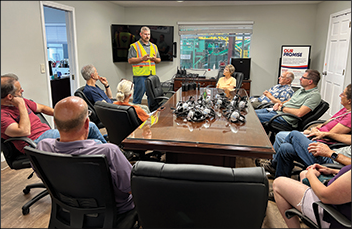
Photo by Tony Peterson
Tour guide Justin Carnes spoke to members of the Sustainable-Suffield-sponsored August tour of the Berlin facility that processes our recyclables.
Another, Jeanne Anthony, visiting with her husband Ken Scharmann, wrote, “Kenny and I were impressed with the technology. We had no idea it was so sophisticated and automated. Seeing the facility in action assured us that recycling is being done to the fullest.”
Anne Borg, touring with her husband, noted in part,” Bob and I enjoyed the tour, amazed by seeing the actual volume of recyclables handled.”