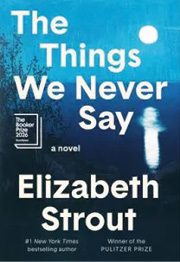
 The Things We Never Say By Elizabeth Strout. 2026, 207 pgs. Random House
This is not another Olive Kitteridge novel, as many of Strout’s books have been; it is a bit of a departure from her usual work in its content, but not in its style, which is always a pleasure to read. The main character is Artie Dam, a high school history teacher beloved by students and colleagues. He loves his work and is very successful at it. His wife is a brisk, no-nonsense, rather cold sort of woman, a contrast in personality to Artie, whom she perceives as slightly weak and ineffectual. Their son Rob is troubled by an automobile accident in which his girlfriend was killed while he was driving.
There is an array of other interesting characters in the book, and soon the reader discovers that many, if not most, of them have something to conceal. Even Artie himself, who on the surface of his daily life seems to be a straightforward, contented person, has anguish buried beneath that surface. As the plot develops, nearly all the characters could be described similarly. Some, including Artie, contemplate suicide. Some carry out such a plan. Throughout the book Artie tries to ask various friends and acquaintances the same question: “Is there such a thing as free will?” He never gets a full answer, but his son Rob comes close: “I think we have it, but not nearly as much as we think we do.”
Artie’s positive influence, unwittingly brought to bear on others, is clearly important–even in some cases a life changer. Among Artie’s students are two young people who learn invaluable lessons from him. Friends love him and depend on him; his son keeps a distance from Artie not because he doesn’t love his father, but because he too holds a dreadful secret and can’t face his kind and honorable parent. Later the young man will have another secret, one which could affect his parents’ life even more profoundly than the first one. “Part of being human,” says Artie to his class one day, “is realizing how private our fears are.” We all suffer fears that no one knows about, as the author points out.
Finally, Rob decides to write a letter to the parents of the girl friend who died in the automobile accident. It is a turning point for him and perhaps for them too. And toward the end of the book Artie realizes that all people “hold within themselves a vast, unknown universe.” You have to give to one another whatever you can, says the author. In other words, free will is an illusion; you just have to cope with what happens to you. Although it is tempting to look for happy answers in books like this one, and although there are moments of positive outcomes in the plot, the overall conclusion is a sad but realistic one. It is not negative, only realistic, to learn to face the ups and downs of life with as much equanimity as possible and to help others to do the same whenever you can. We are all familiar with the old quote, “No man is an island;” in this book the hero learns that every man is an island.