Trivia questions were formed from Suffield Notes by Samuel Lathrop, 1945
1. Charles F. Loomis expressed his wealth in many ways in his lovely house built in 1862 which is still standing on North Main Street just south of Marbern Drive. What was one of the features of the house in Loomis’ lifetime?
a. A sunken pool.
b. Steam pipes that vented cooking smells outside.
c. A machine which provided lighting to the house and yard by piping gasoline vapor to jets.
2. Is there a time capsule in the cornerstone of the old Kent Memorial Library (now the Suffield Academy’s S. Kent Legare Library)? Yes or no.
3. Suffield had two racetracks. One racetrack was behind McAlister Intermediate School. Where was the other one?
a. On South Main Street, near Limric Lane.
b. Across from Hilltop Farm.
c. On South Street.
4. Factory Lane was located at the southern-most end of High Street (now called South Main Street). The lane was named for the fulling mill located there which processed woolen cloth into felt. What else can be said about Factory Lane? Select all answers that are correct.
a. It was the only paved road in town.
b. It was the only way to get to South Street from High Street.
c. It was also called Horseway.
5. In the 1890s, the neighborhood of the southern part of High Street had a colloquial name. What was it?
a. Eelsville.
b. The South.
c. Milltown.
6. Around 1895, in the Loomis Block of the old town center was the fraternal organization Lyman Council 35, Order of United American Mechanics. The Chapter was named after the Suffield hero Phineas Lyman. The secret society organization, begun in 1845, was very popular throughout the country. What did it promote?
a. It promoted American labor and opposed immigration.
b. It promoted American labor, moral values and brotherhood.
c. It promoted American labor and charity.
7. Another secret society shared the same hall with the United American Mechanics. It was called the Gideon Granger (another favorite Suffield son) Lodge, Knights of Pythias. What did it promote?
a. The acquisition of money.
b. Catholicism.
c. Loyalty, honor and friendship.
8. The Old Town Hall, demolished in the redevelopment of the town center, replaced an earlier Town Hall which was built in 1797 but burned down in 1860. The Old (but “newer”} Town Hall was built with local native material. What was it built with?
a. Clapboards made from chestnut trees felled in Suffield’s Wolf Pit Plain.
b. Sandstone for its foundation from the Copperhill Quarry.
c. Bricks made on North Street.
9. The office for recruiting Union soldiers during the Civil War was located where?
a. The post office in the Old Town Hall.
b. The Austin Tavern on South Main Street.
c. The lobby of the 2nd Baptist Church.
10. Bridge Street School, built in 1924 and demolished in 2021, was built on the site of what building?
a. Calvary Episcopal Church.
b. The Masonic Temple.
c. The Old Town Hall.
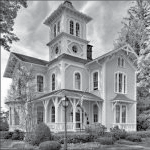
Photo provided by the author
Charles Loomis House
Answers:
1. c. A Gilbert & Barker machine provided lighting to the house and yard by piping gasoline vapor to jets. YIKES! Gilbert & Barker later made gasoline pumps for automobiles.
2. Yes. On a rainy afternoon in 1898 a copper box was placed in the northeast cornerstone of the building.
3. On South Street. Martin Sheldon donated his property known as Sheldon Park for a racetrack which was west of the old South Street (fire) station and north of Spencer Brook. This racetrack was in use until the Suffield Agricultural Society set up fairgrounds with a racetrack behind McAlister School. Martin Sheldon lived in the fabulous house on the turn from South Main Street to South Street.
4. b. and c. are correct. For a time, there was no connection to South Street (which was also called Country Road). I do not know when an official town road connected the two streets. Horseway was also the name for the lane because horses could travel on a causeway to the mills located on the brook.
5. a. Eelsville. There must have been good fishing in the brook, particularly for eels.
6. a. Members were restricted to white native-born Protestant males. It promoted sobriety, American labor and opposed immigration, particularly immigrating Catholics.
7. c. Loyalty, honor and friendship. Founded in 1864, its members were white males in good health (disabled persons were not admitted as members until 1875), who did not sell liquor, were not Communists or Fascists, and believed in a Supreme Being. Both the United American Mechanics and Knights of Pythias disbanded in Suffield around 1912.
8. c. Bricks made in the William King brickyard on North Street.
9. c. The lobby of the 2nd Baptist Church.
10. a. Calvary Episcopal Church.