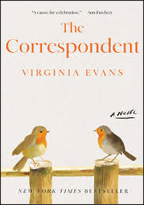
The Correspondent By Virginia Evans 2025 304 pgs. Crown Publishing
This is an extraordinary book, one that will appeal to any reader, but particularly to readers in what the author calls the “fourth season” of life–that is to say, the winter season. The book is a series of letters written by Sybil, a retired lawyer, to family members, friends, and various other people in her life. Sybil is outspoken and tenacious, sharp tongued with others, but also honest with herself and willing to explore the mistakes she has made and the regrets she holds.
There are other interesting characters whose personalities and relationships emerge through the letters: Sybil’s two adult children Bruce and Fiona; her brother Felix; her best friend Rosalie; her neighbor Theodore Lübeck; her half-sister Hattie; and multiple other less major characters. The pattern of the content of the letters often has to do with the way Sybil is able to turn potentially confrontational exchanges into warm encounters, although some of them show raw anger and injured feelings on one or both sides.
Throughout the correspondence there is a trail of unexplained guilt. There are also a number of letters unsent, a kind of mystery. Sybil’s inner life is clearly one of professional success but also failure in some (not all) personal relationships, causing hidden sorrows. In addition to what is going on internally, she knows that she is losing her eyesight, slowly going blind by degrees. Since reading and writing are of enormous significance to her wellbeing, this is a fearful phenomenon in her life, but one that she faces bravely.
Old age–Sybil is in her late seventies–is a season of loss, universally: loss of physical abilities once taken for granted; loss of strength; loss of health, often loss of home; loss of friends and family members; even, as with some minor characters in the book, loss of mental health.
Sybil, to her credit and with help from various others, finds herself able and willing to take on startling new experiences even as her eyes fail her. Finally, she confronts the guilt that underlies this plot, confessing its cause in a long letter to a person relatively new in her life. It is a catharsis of sorts, and one suspects, a healing one.
It is hard to convey the impact of this book, its meaningfulness, its effectiveness in conveying emotion. It is skillfully written, not through particularly elegant language or poetic descriptions, though there are some of those, but through unspoken nuances that allow the reader access to Sybil’s inner life. The overall sense the book offers is that these are real people, genuine human beings, a family not perfect–a family you could say is dysfunctional–described by a member of the family immersed in its contradictions, in its giving and taking, in its ups and downs, in its joys and sorrows. The Correspondent is unforgettable.