Are you considering trading in an older car or truck that runs well but lacks modern safety warning systems?
There could be a less expensive alternative.
Reliable safety alert equipment can be installed in your older car and work well, though without all the features of new car systems.
Take a forward collision warning system, for example. It can cost about $450 installed, depending on your car, and alert you with a sound and red light if you’re approaching a stopped car or pedestrian too fast. But unlike many new car systems, it won’t automatically apply the brakes because it’s not integrated with your car’s electronics.
Other systems include blind-spot monitoring that alerts you to cars approaching in adjoining lanes, backup cameras, cameras that record drivers around you for proof of unsafe driving in the event of an accident, and front and rear sensors that help you park without bumping into other cars. Some devices, like the aforementioned forward collision warning system, can combine multiple functions.
For this article, I phoned five Connecticut and Massachusetts installers of car safety warning systems and visited one who impressed me most with his knowledge and willingness to answer questions by phone.
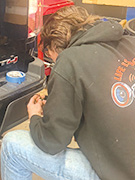
An Act technician installs parking sensors on a GMC truck.
James Smith, owner of Act Audio in Vernon, has been installing car safety monitoring equipment since 2008. He’s a low-key professional who said he offers only mid- to high-end equipment and is meticulous about installation, such as safely routing wires. He said many new car dealers bring cars to him for the installation of systems that manufacturers don’t offer. His work doesn’t void new-car warranties, he stressed.
According to the Mobile Electronics Certified Professionals (MECP) website, Smith’s firm is one of only three New England shops that employ certified technicians.
The MECP is a certifying body that offers three levels of certification for technicians: Apprentice, Skilled and Expert. To achieve the different levels, technicians need to take a variety of courses, some lasting eight to 10 hours, and pass tests. Two of Smith’s five installers, including him, are MECP certified. He said, “Cars today are very advanced, and most shops don’t participate in training or certification programs.”
Only one other shop convenient to Suffield residents employs MECP-certified technicians. It’s Innovative Concepts of Wilbraham. Smith knows the owner and endorses his work, even though they are competitors, which speaks to Smith’s integrity.
What you should expect to pay
Backup cameras with an external monitor or special rearview mirror that turns on only when you put your car in reverse can cost about $500. Replacing an existing radio with a radio/display that shows a rear view while backing up will cost considerably more.
For front- and rear-facing cameras, called Dash Cams, that record drivers around you, expect to pay about $500 total.
Blind-spot sensors that detect cars in adjoining lanes approaching you require the removal and reinstallation of bumpers. They cost about $900, including alert lights on the front roof support pillars inside the car.
Front and rear parking sensors are about $600 installed.
The prices quoted are rough figures. Depending on your vehicle model, you may pay more or less. Smith said installing equipment on older Toyotas can be in line with the quoted prices, whereas installation in BMWs and Mercedes is typically much more expensive due to their complex electronics.
If you’re interested in upgrading your older car with modern safety equipment, I’d visit a store like Act Audio to view their selection and let the James Smiths of the world help you determine exactly what’s right for you.
Don’t expect the installation of safety warning systems in older vehicles to yield you much savings in car insurance. My insurer, Amica, said they offer only one discount, and that’s for forward collision warning systems, as mentioned in this article. It amounts to about $10 annually.
Few customer complaints
When I asked Smith about customer complaints, he said they are minimal. He noted that the equipment he installs is reliable and cautioned prospective buyers not to be lured in by prices they see on Amazon, which might be for low-quality systems and don’t include professional installation. He said customers occasionally experience false alarms that require sensor adjustment, yet system recalibration is typically needed only when a driver bumps a camera that requires realignment.