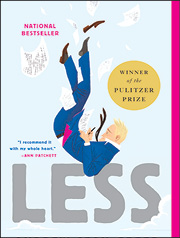
LESS By Andrew Greer 2017, 273 pgs., Kindle
Won 2015 Pulitzer Prize for Fiction
Arthur Less is a gay writer who is about to turn 50; the very thought sends him into mild depression. In addition, his lover Teddy has departed and is about to be married. And to top it all off, his publisher has refused his latest book and his income is drying up. He has become a “minor novelist.” He continues to be invited to speaking engagements, most of which turn out to be badly attended and fairly meaningless. He is desperate and he is lonely. Life holds no joy for him, and his future looks grim.
All of this misery is related by the author in wonderful prose, funny and tongue-in-cheek, but also poignant. Arthur decides to take a trip around the world, an itinerary arranged by his agent, with stops and funded appearances in New York, Mexico City, Turin, Berlin, Marrakech, an Indian retreat center and Kyoto. Arthur is pleased with this prospect, because he will have an excuse not to attend Teddy’s wedding. So, he packs his bags and heads off to new adventures, hoping also to find inspiration for a new book.
Arthur’s experiences on this journey give the reader an insight into the life of a gay middle-aged man. Some of them are hilarious, some touching, some sad, as he makes his way from country to country and from audience to audience. He often despairs of the whole idea of love, of its possibility and especially of its sustainability. He remembers his first long lasting love affair with an older man, a famous poet who left his wife for Arthur. Although Arthur remembers the man with great fondness, he is also filled with guilt for having destroyed the man’s marriage.
Still, Arthur meets many interesting people on his trek and begins to see ways to revise his failed novel; he is told that it is not “gay enough.” The gay characters all come to a bad end, when they deserve better. So, he begins to rewrite, and his spirits slowly begin to lift. LESS has a happy ending; if you enjoy puns, you could say “Less has more.” Arthur experiences a restoration of confidence, a new faith in the value of love, good progress in the novel he is rewriting, and pleasure in life. He returns home in much better shape than when he left, even though he has to deal with the fatal illness of the aging poet whom he still admires. But he has developed the resilience he needs to cope with difficulties, and he looks forward to his future. This turns out to be a book of hope, a book of unexpected optimism, and a glimpse into the trials and tribulations of an important but often misunderstood segment of our population.