Agriscience Teacher Gains Certification

Rebecca Ferguson, an agriscience educator at Suffield High School, recently attended a two-week virtual professional development institute through Carroll County, Maryland, to teach the Natural Resources and Ecology Curriculum for an Agricultural Science Education (CASE) course at the Suffield Regional Agriscience program. Rebecca was one of 24 educators from 10 different states to attend this institute. CASE is an instructional system that is changing the culture of agriculture programs in the United States through intense teacher professional development, inquiry-based, student-focused lessons, assessment and certification. CASE equips teachers to elevate student experiences in the agriculture classroom and prepares students for success in college and careers emphasizing science, technology, engineering, and math (STEM). In 2009, schools began implementing CASE into their programs. More than 2,000 teachers from 45 states, plus the Virgin Islands, hold close to 3,000 certifications and use them each day in their agriculture classrooms.

During the CASE Institute, Rebecca spent over 70 hours working through nearly every lesson in the year-long curriculum and learning how to deliver inquiry-based lessons in a way that will shift focus in the classroom from teacher-led to student-directed learning.


Joseph Seger, Original Suffield Proprietor

On May 19, 1679, Joseph Seger was granted forty acres by John Pynchon’s Committee for Suffield.

A Moment in Time: Old Photos Invited from Our Readers

These three houses with deep front yards on the east side of North Main Street, pictured in about 1920, are still there, but all three have been significantly remodeled, and large trees have grown to obscure the view. Front to rear: #310, #318, #332.

Food for Thought

“Today is April Fools’ Day. Believe nothing, trust no one – just like any other day.” – Unknown

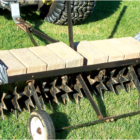
Keep Your Lawn Healthy: Aerator Anyone?

A yard can become hard packed from frequently walking or playing games on it or lawn mowing. A hard-packed lawn may not efficiently receive much needed water, air, nutrients, seeds, etc. Aerating involves cutting little openings in the soil to create small reservoirs, which will bring benefits of water, oxygen, fertilizer, etc. down into the root zone. Indications that

a lawn needs aerating:

Lawn is full of water after the rain

Frequent driving on the lawn with a car or other transport

If it’s hard to stick a pencil or similar item into the soil’s surface

It’s hard clay soil

Bare or thin grass areas

Soil compaction

When to use

a lawn aerator?

Suffield Rotary Club News

Suffield Rotary challenged the Knights of Columbus to a Cornhole Tournament at the end of January. The Knights won, but Suffield Rotary is practicing to regain the trophy. Knights – watch out!

West Suffield Fire Mark

In 1853 not having a fire mark could be disastrous. A hapless home-owner could find himself arguing price with three fire chiefs while his house burned to the ground. One fellow not only lost his house, he lost his life when the argument became as heated as the fire. A fire mark would have prevented all that by indicating which fire company would fight the blaze. Those were the days when insurance companies practically owned the fire companies.