Suffield 350th Anniversary Committee
March Trivia Quiz Answers
|
1) a. 2) b. 3) b. 4) b. 5) a. 6) d. 7) d. 8) c. 9) b. 10) a.
The Suffield Observer (https://thesuffieldobserver.com/2019/03/page/7/)
1) a. 2) b. 3) b. 4) b. 5) a. 6) d. 7) d. 8) c. 9) b. 10) a.
Bog ore is the answer to the fifth question in the Suffield Trivia Contest located in the February issue of The Observer. The question was, “Suffield had a mineral found in swamps that was very useful. What was it?” Bog ore (or bog iron) was widely sought in colonial America. It was smelted and made into iron. According to Robert Alcorn in his book, The Biography of a Town, bog ore was found in the low area between Sheldon Street and North Grand Street in what was known as the Pancake Swamp.

Get ready for our semiseptcentennial anniversary in 2020 by helping to create a board game celebrating our 350-year history! The illustration above is from a game created for Scranton, but “Trivia Quest Suffield & West Suffield” will be modeled on our community, featuring prominent buildings, public lands, and community organizations framed by the Connecticut River and the Congamond Lakes. The board consists of yellow, blue, orange, red, green and purple spaces. Each color has a corresponding dollar value. Questions are progressively more challenging based on the monetary value, with yellow being the easiest and purple the most challenging.
One of the projects for Suffield’s 350th anniversary celebration is to republish Robert Alcorn’s The Biography of a Town – Suffield, Conecticut 1670-1970, published in 1970 along with a Volume 2, which would be a compilation of Suffield stories from the last 50 years that brings us from the late 1960s, where Alcorn’s book left off, through the past 50 years to 2020. Our tentative idea is to call it 50 Stories for 50 Years. We are looking for residents (or former residents) who have a story to tell. The stories might be about growing up in Suffield, about the farming community, about your church, your committees, your non-profit group, education, real estate, development in town, etc. and how these stories have evolved over the past 50 years from the 1960s to now.
Congratulations to Mary Fiore and John Emrick! Both contestants correctly answered the trivia questions published in the February issue of the Observer. Answers to February Questions
1) e. Depot Street
2) Yes
3) b. 1743
4) c. Crooked Lane
5) c. Bog ore
6) a. Separates
7) b. One was the U.S. Postmaster General, and the other was the U.S. Assistant Postmaster General at the same time. 8) c. Oliver Phelps started a silk manufacturing plant in Suffield, inspired by a packet of mulberry seeds sent to each parish in Connecticut. (Mulberry trees are the food of the silkworm.)
9) Yes
10) a. Impartial Herald
1. In 1802, it was voted that students provide what for their teacher? a. a quarter cord of wood b. a horse c. housing and meals, payment shared by all d. blackboard and school books 2. What was opened in 1809? a. the Connecticut Baptist Literary Institution b. the first bridge over the Connecticut River in Conecticut c. the “Poor House” d. the […]
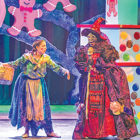
If what Scottish philosopher Thomas Carlyle said is true that, “Music is well said to be the speech of angels”, then Suffield native/ coloratura soprano Brynn Scozzari is talking in good company. Brynn, a 2007 SHS graduate, attended Roanoke College in Virginia, took voice lessons and majored in vocal performance, graduating with a BFA in music and voice. Shortly after, she was accepted into the recently formed apprentice program at Opera Roanoke, a regional opera company where she had the opportunity to work with professional guest artists, sing in main stage productions, perform in outreach programs, and learn about stage managing, choreography, and opera production. She made her opera debut singing in the chorus of the Flying Dutchman and followed it up with chorus parts in the Pirates of Penzance, The Magic Flute, and Julius Caesar. She made her solo debut singing in The Masques of Orpheus.

The editorial carton reflects the view of the creator and is not necessarily endorsed by The Suffield Observer.
“Man cannot live by bread alone; he must have peanut butter.” – James A. Garfield
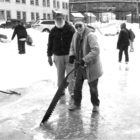
Each year, when the weather permits, Dennis Picard holds a public demonstration of ice harvesting at the Noble & Cooley mill pond in Granville, just north of North Granby. This year the weather on February 2 was great, the ice was clear and over a foot thick, and appreciative visitors enjoyed the demonstration and explanations by Picard, a knowledgeable historian and former director of the Storrowton Village Museum at the Big E.
Many onlookers each year accept the invitation to take hold of one of Picard’s ice saws and learn how to cut the long slices of ice which can then be split into chunks, floated off, and lifted out with big iron tongs. This year one of the students was this writer, who brought an old Connecticut ice saw recently donated to the King House Museum by Eric Haffner. The saw was very similar to the ones that Picard brought, and he said that type of saw was manufactured from 1819 to 1919. He dated the one I brought to about 1880 and called it a nice example because it retained the original pin and wedge that secure the blade to the handle.